Featured artworks
Artworks that are part of this exhibition.
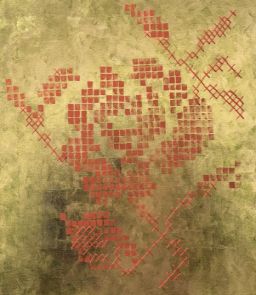
"Rose" from the "Weaving Traditions" series
by Irina Berlizova • 2026
Dimensions: H 78.34 x W 80 cm
Medium: mixed
Dimensions: 80 x 80 cm. The composition is built on the contrast between a warm, shimmering golden background made of gold leaf, which seems to glow from within, and the strict geometry of red squares embroidered with wool. These squares form figures floating freely in space, coming together into a single pattern. Red crosses and grids along the edges introduce the rhythm of a hand-made, almost naive style, while the textured heterogeneity of the background gives the surface depth and vitality. This work sits on the border between abstraction and ornament, where line and color speak not of a plot, but of a state—of gold as light, of red as a sign of life, and of the very process of embroidery as a meditative practice.
$ 1000
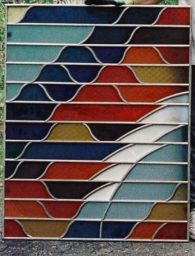
Stained Glass "Hammer and Sickle"
by Vintage Moll • 1970
Dimensions: H 119.74 x W 85.5 cm
Medium:
Dimensions: 115 x 85.5 cm. This stained glass once illuminated the workshops and the factory club. The "Hammer and Sickle" plant is a legend of Soviet metallurgy: from a small factory owned by a French entrepreneur, it grew into a giant that supplied the country with metal, survived through wars and reconstructions, and gave the nation its first electric furnaces and new steel production technologies. In 1961, the plant approached the Surikov Institute, specifically the Sculpture Department, with a proposal to erect a monument to the fallen. On June 1, 1966, a sculpture appeared on the site of the foundation stone: figures of soldiers against a wall symbolizing the border that the enemy was not allowed to cross, and a bronze ribbon bearing the words of Olga Berggolts: "No one is forgotten, nothing is forgotten." In 1975, memorial plaques were installed nearby, and the monument received a new name—"Metallurgists to their Fallen Comrades." It was created on the initiative of the plant's workers themselves: they transferred 5% of their earnings for one day into the fund, and many contributed personal funds as well. The memorial plaques are engraved with the names of the fallen—some of them were restored from memory and the testimonies of colleagues and relatives.
$ 26000
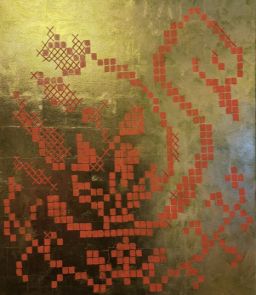
"Guardian" from the "Weaving Traditions" series
by Irina Berlizova • 2026
Dimensions: H 78.34 x W 80 cm
Medium: mixed
Dimensions: 80 x 80 cm. The composition is built on the contrast between a warm, shimmering golden background made of gold leaf, which seems to glow from within, and the strict geometry of red squares embroidered with wool. These squares form figures floating freely in space, coming together into a single pattern. Red crosses and grids along the edges introduce the rhythm of a hand-made, almost naive style, while the textured heterogeneity of the background gives the surface depth and vitality. This work sits on the border between abstraction and ornament, where line and color speak not of a plot, but of a state—of gold as light, of red as a sign of life, and of the very process of embroidery as a meditative practice.
$ 1000
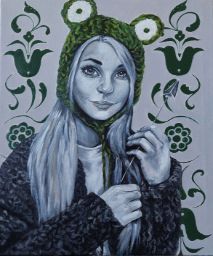
"Guardian of the House" from the "Weaving Traditions" series
by Ekaterina Mogaeva • 2026
Dimensions: H 51.04 x W 40 cm
Medium: oil
Dimensions: 40 x 50 cm. Before us is a contemporary interpretation of a folklore archetype: the portrait of the "Frog Princess" is rendered in a cool, almost graphic monochrome palette with accents of green, where the heroine in a knitted hat with "frog" eyes appears not as a fairy-tale character, but rather as an ironic and vulnerable modern image. The composition is built on the contrast between the restrained, almost monochrome face and the active ornamental background, reminiscent of either Russian embroidery or a floral pattern, which translates the well-known plot into a register of personal experience and quiet irony. Decorative elements and naivety coexist here with inner tension, and the image itself reads as a metaphor for finding one's place between tradition and modernity, between fairy tale and everyday life.
$ 680
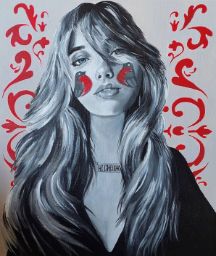
"The Princess Who Never Laughed"
by Ekaterina Mogaeva • 2026
Dimensions: H 50.34 x W 40 cm
Medium: oil
Dimensions: 40 x 50 cm. The composition is built on the contrast between a cold, almost graphic monochrome portrait and bright red ornamental shapes along the edges, reminiscent of either traditional embroidery or protective signs. The birds on the heroine's cheeks and the inscription "not funny" on her neck translate a well-known folklore archetype into a modern, ironic, and vulnerable register. It is an attempt to capture the subtle state between dream and reality, between who we are and who we once were—and to find in the naive and the fantastic an astonishing truth that is difficult to express in words.
$ 680
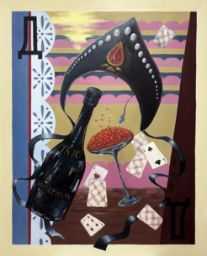
"The Triumph of the Russian Soul: By Mind and Measure"
by Olga Golybkova • 2026
Dimensions: H 100.45 x W 80 cm
Medium: oil
Dimensions: 80 x 100 cm. Before us is a vivid example of a contemporary postmodern still life, where an academic painting style is combined with playful theatrical imagery: in the center of the composition, against a conditionally decorative backdrop with stripes of a sunset sky, a scene-manifesto unfolds, built on allegories of Russian culture. A kokoshnik with the emblem of the Queen of Spades, a bottle of "Imperial" champagne dated 1870, caviar in a glass caviar dish, bridge cards, and falling black ribbons—all this forms a complex visual text in which luxury does not equal vulgarity, and excitement gives way to intellectual strategy. The composition deliberately breaks the boundaries of the frame: the ribbon of the kokoshnik extends beyond its limits, and the letters "D" and "P" on the edges remind us of the literary primary source—Pushkin's "The Queen of Spades." The color palette is built on the contrast of deep black, gold, crimson-pink, and red, while the textured painting gives the image an almost stage-like volume. This work is about the Russian soul—not tragic or drunken, but triumphant, intelligent, and ironic, where leisure turns into an act of high culture, and the game is a way to speak about fate, literature, and imperial dignity without unnecessary words.
$ 1500
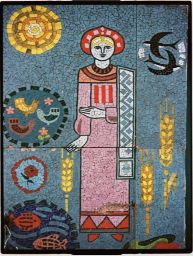
Mosaic
by Vintage Moll • 1960
Dimensions: H 260.15 x W 172 cm
Medium: mixed
Dimensions: 293 cm x 172 cm. This mosaic once decorated the walls of the motor depot of the Academy of Sciences. It all started here with just a few trucks, but over time the facility grew, eventually servicing the entire academic science sector. During the war years, this depot became indispensable: vehicles were repaired here for the front lines. In the post-war years, it remained the backbone of the scientific cluster—already under the name "Akademavtotrans"—providing transport for the Academy. In the 90s, it found a second life: auto repair shops, a driving school, and a car wash—the place became vital to the city once again. From here, cars departed on expeditions, drove academics to meetings, and supplied the institutes. This mosaic was seen by drivers, mechanics, and scientists who came here every day to pick up their cars.
$ 34515
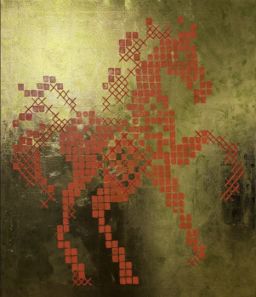
"Guardian of the House" from the "Weaving Traditions" series
by Irina Berlizova • 2026
Dimensions: H 78.94 x W 80 cm
Medium: mixed
Dimensions: 80 x 80 cm. The composition is built on the contrast between a warm, shimmering golden background made of gold leaf, which seems to glow from within, and the strict geometry of red squares embroidered with wool. These squares form figures floating freely in space, coming together into a single pattern. Red crosses and grids along the edges introduce the rhythm of a hand-made, almost naive style, while the textured heterogeneity of the background gives the surface depth and vitality. This work sits on the border between abstraction and ornament, where line and color speak not of a plot, but of a state—of gold as light, of red as a sign of life, and of the very process of embroidery as a meditative practice.
$ 1000
Curatorial Statement
Artist Information
Евгеня Остроумова