
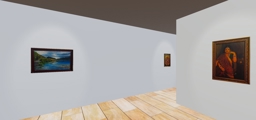
 Anuragk Gupta
’s practice is a profound exercise in Spiritual Architecture, where the canvas serves as a blueprint for the soul. This collection marks a pivotal synthesis in his journey, merging the precision of geometry with the fluid mystery of the divine. To understand Gupta’s work is to witness a dialogue between the seen and the unseen, structured around three core pillars. In Gupta’s visual language, Libre Essence, there is no hierarchy between the figure and the abstraction. He views the figurative as the "vessel"—the physical manifestation of energy—and the abstract as the "breath" or the "pulse" within that vessel. His ontological spirals act as the bridge between these two states. By placing a recognizable form alongside a geometric void, Gupta illustrates the transition of consciousness: the figure represents our human presence, while the abstraction represents our infinite potential. Together, they reflect the totality of existence—the form and the formless existing in a single, continuous loop. Gupta’s spiritual architecture is not bound by geography; it is a confluence of Indian Tantric philosophy, Tibetan mysticism, and universal geometry. From Indian tradition, he draws the concept of the Mandala and the Bindu, focusing on the center as the source of all creation. From Tibetan influences, he adopts a sense of cosmic rhythm and the interplay of elemental forces. By stripping these traditions down to their "Libre Essence," he reaches a Universalism that resonates with the modern seeker. He approaches spirituality as a global human technology—a way of mapping the internal landscape that transcends religious dogma to reach a state of pure, visionary presence. For Gupta, the act of creation does not end when the paint dries; it extends into the world as an act of service. He views charity not as a moral obligation, but as a natural extension of high consciousness. Just as his "Spiritual Modernist" paintings seek to balance energy on the canvas
 133 visitorsView Details