Featured artworks
Artworks that are part of this exhibition.
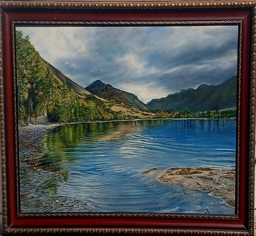
Serenity
by Anuragk Gupta
Dimensions: H 24 x W 36 in
Medium: Oil
A tranquil convergence of water, land, and sky, Serenity offers a pause where nature appears to breathe as one. The work invites quiet reflection, suspending urgency and restoring balance through stillness, openness, and a timeless sense of inner equilibrium.
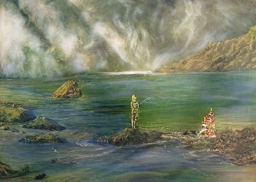
Gone Fishing
by Anuragk Gupta
Dimensions: H 18 x W 30 in
Medium: Oil
Solitude unfolds as a sacred ritual in this contemplative landscape. A solitary figure stands in quiet devotion, transforming ordinary labour into meditation. The painting honours patience, presence, and the dignity of still moments where life listens to itself.
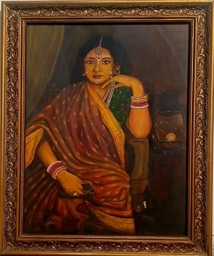
Radiance of Laxmi
by Anuragk Gupta
Dimensions: H 36 x W 24 in
Medium: Oil
Blending earthly grace with divine symbolism, this work portrays prosperity as wisdom and quiet strength rather than excess. The serene figure embodies feminine auspiciousness, grounding abundance in dignity, restraint, and an inwardly cultivated sense of grace.
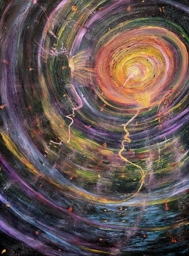
Spanda
by Anuragk Gupta
Dimensions: H 24 x W 18 in
Medium: Oil
Rooted in the philosophy of vibration, Spanda reveals creation as rhythmic awareness. Colour and movement pulse where Shiva and Shakti meet, suggesting that existence arises not from form, but from the eternal tremor of conscious becoming.
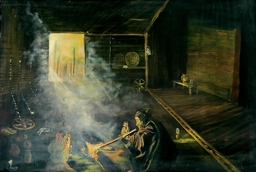
Whispers of Winter Morning
by Anuragk Gupta
Dimensions: H 24 x W 36 in
Medium: Oil
Smoke, firelight, and muted interiors evoke a winter dawn where survival and tenderness coexist. This work captures warmth emerging from restraint, suggesting that even in scarcity and cold, life awakens softly through shared silence and human endurance.
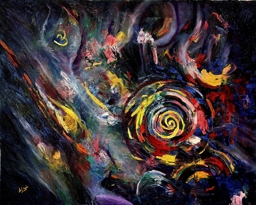
Ananta Naad
by Anuragk Gupta
Dimensions: H 18 x W 24 in
Medium: Oil
Infinite sound emerges as living vibration in swirling spirals of colour and rhythm. Ananta Naad visualizes consciousness before form—where breath, resonance, and movement awaken awareness in a primordial field of becoming.
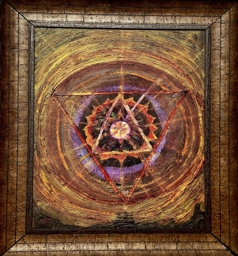
Kaala Chakra
by Anuragk Gupta
Dimensions: H 24 x W 18 in
Medium: Oil
Time reveals itself as an eternal wheel, revolving around an unchanging center. Sacred geometry and opposing forces coexist in balance, suggesting that motion and stillness are not opposites, but partners within a cosmic, timeless order.
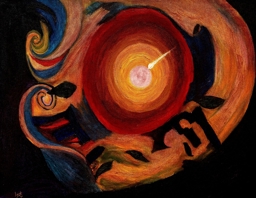
Vision of Eternity
by Anuragk Gupta
Dimensions: H 18 x W 24 in
Medium: Oil
A luminous core gathers spiraling forms inward, revealing eternity not as distance but as living presence. The painting suggests a moment where individual awareness softens and merges with an infinite source—where time, self, and movement dissolve into a single, breathing field of consciousness.
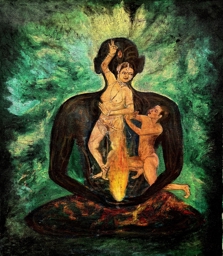
The Kundalini Awakens
by Anuragk Gupta
Dimensions: H 24 x W 18 in
Medium: Oil
This restrained composition reflects inner ascent without spectacle. Through balanced form and tonal control, the painting suggests consciousness rising inwardly—present, alert, and grounded—honouring transformation as a quiet, disciplined unfolding rather than dramatic release.
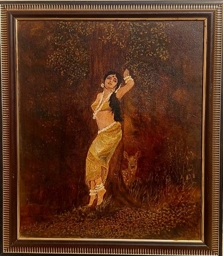
Shakuntala
by Anuragk Gupta
Dimensions: H 18 x W 12 in
Medium: Oil
Portraying Kalidasa’s heroine in quiet communion with nature, Shakuntala reflects innocence shaped by longing. The forest becomes a living witness to emotion, memory, and anticipation—holding the tender space between solitude, love, and destiny.
Curatorial Statement
Anuragk Gupta’s practice is a profound exercise in Spiritual Architecture, where the canvas serves as a blueprint for the soul. This collection marks a pivotal synthesis in his journey, merging the precision of geometry with the fluid mystery of the divine. To understand Gupta’s work is to witness a dialogue between the seen and the unseen, structured around three core pillars. In Gupta’s visual language, Libre Essence, there is no hierarchy between the figure and the abstraction. He views the figurative as the "vessel"—the physical manifestation of energy—and the abstract as the "breath" or the "pulse" within that vessel. His ontological spirals act as the bridge between these two states. By placing a recognizable form alongside a geometric void, Gupta illustrates the transition of consciousness: the figure represents our human presence, while the abstraction represents our infinite potential. Together, they reflect the totality of existence—the form and the formless existing in a single, continuous loop. Gupta’s spiritual architecture is not bound by geography; it is a confluence of Indian Tantric philosophy, Tibetan mysticism, and universal geometry. From Indian tradition, he draws the concept of the Mandala and the Bindu, focusing on the center as the source of all creation. From Tibetan influences, he adopts a sense of cosmic rhythm and the interplay of elemental forces. By stripping these traditions down to their "Libre Essence," he reaches a Universalism that resonates with the modern seeker. He approaches spirituality as a global human technology—a way of mapping the internal landscape that transcends religious dogma to reach a state of pure, visionary presence. For Gupta, the act of creation does not end when the paint dries; it extends into the world as an act of service. He views charity not as a moral obligation, but as a natural extension of high consciousness. Just as his "Spiritual Modernist" paintings seek to balance energy on the canvas
Artist Information
Anuragk Gupta